Updated July 29, 2026. Prepared for Impact Restore, commercial and industrial restoration, 21 Goodrich Rd Unit 10, Etobicoke, ON M8Z 6A3. Emergency line 647-951-0906.
Direct Answer
Water damage restoration in Toronto is the process of extracting water, drying a building’s structure to a documented dry standard, and restoring affected materials after a flood, burst pipe, or sprinkler discharge. Commercial work follows ANSI/IICRC S500, the fifth edition of which was published in 2021. [1]
TL;DR
- The governing document is ANSI/IICRC S500, Fifth Edition (2021). Almost no Toronto restoration page names it, which makes it hard to tell whether a contractor works to a standard or to a guess. [1]
- Health Canada sets specific mould thresholds by area. A single patch larger than three square metres requires professional assessment and cleanup. [3]
- Health Canada does not recommend air testing for mould in most situations, and advises against using bleach to clean it. [3]
- The July 15 and 16, 2024 flooding across Toronto and southern Ontario produced insured losses revised upward to roughly $991 million. Add the August storms and the region passed $1 billion in flood losses inside one month. [6][5]
- If City infrastructure caused the loss, Toronto pays only where negligence is proven, and failing to report to 311 can weaken that proof. [9]
- Toronto’s Basement Flooding Protection Subsidy is limited to single-family, duplex, triplex and fourplex residential owners. Commercial properties do not qualify. [11]
One liner: commercial water damage in Toronto is a standards-driven, documentation-heavy process, and the parts that decide your insurance outcome happen in the first few hours.
Key Numbers
| Figure | Value | Source and date |
| Governing standard | ANSI/IICRC S500, Fifth Edition | IICRC, 2021 [1] |
| Mould onset in an area with excess moisture | Within 48 hours | Health Canada, January 2023 [3] |
| Threshold requiring professional mould cleanup | A single patch over 3 square metres | Health Canada, January 2023 [3] |
| Recommended indoor relative humidity | 30 to 50 percent | Health Canada, January 2023 [3] |
| July 15 to 16, 2024 GTA and southern Ontario flood, insured losses | Revised to about $991 million | CatIQ and Perils AG, January 2025 [6] |
| August 17 to 18, 2024 GTA storms, insured losses | Over $100 million | CatIQ, January 2025 [6] |
| Canadian insured losses, 2024 | $8.5 billion, the costliest year on record | Insurance Bureau of Canada, January 2025 [7] |
| Canadian insured losses, 2025 | Over $2.4 billion, tenth costliest on record | Insurance Bureau of Canada, January 2026 [8] |
| Typical City of Toronto flood claim resolution | About 90 days | City of Toronto [9] |
| Ontario basic limitation period | Two years from discovery | Limitations Act, 2002, s. 4 [12] |
What Commercial Water Damage Restoration Covers in Toronto
In short: Commercial restoration covers emergency extraction, structural drying, and the documented return of a building to a dry standard, and it is a different discipline from residential work because of scale, occupancy, and reporting obligations.
Water damage restoration is often used as a catch-all phrase, but the work splits into two phases with different goals. Mitigation is everything done to stop the loss from growing: shutting off the source, extracting standing water, removing unsalvageable materials, and setting up drying equipment. Restoration is what follows, returning finishes and assemblies to their pre-loss condition.
For a commercial building the mitigation phase carries most of the risk. A warehouse with 40,000 square feet of slab, a healthcare facility with occupancy constraints, and a downtown office tower with a shared riser all fail differently from a house. Access windows are narrower, tenants have to keep working, and the loss usually touches more than one party’s insurance.
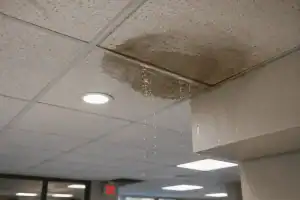
The property types that generate most commercial water losses in Toronto are consistent: office buildings, retail and hospitality space, warehouses and distribution centres, manufacturing plants, healthcare facilities, education buildings, and condominium and multi-tenant residential corporations managed as commercial accounts. [13] The sources are equally consistent: burst pipes and plumbing failures, sprinkler and fire suppression discharge, roof leaks and window infiltration, stormwater intrusion, and sewage backups. [13]
The practical difference between a commercial and a residential contractor shows up in three places. Equipment capacity, because drying a slab is not the same as drying a basement. Scheduling, because commercial work often has to happen overnight or in phases. And documentation, because a facility manager has to hand something to an insurer, an owner, and sometimes a regulator.
The First 24 Hours: A Facility Manager’s Sequence
In short: Safety first, then stop the source, then report, then document. The order matters, because two of these steps protect your insurance position and cannot be recreated later.
Make the area safe. Standing water and live electrical service are the immediate hazard. Health Canada’s flood guidance is blunt about it: shut power off to the flooded area at the breaker box and ask the utility for help if needed. Wear rubber boots while standing in water and keep extension cords out of it. [3]
Stop the source. Isolate the failed line, close the sprinkler control valve, or shut the building’s main. If the source is outside your control, such as a surcharged municipal sewer, containment becomes the priority instead.
Call it in. Two calls, not one. Your restoration contractor, and, if the water may have come from City infrastructure, 311. That second call is the step nearly every restoration page in this market omits, and it has direct financial consequences. The City states that failing to report the incident to 311, which denies Toronto Water the opportunity to investigate, could affect your ability to prove that damage was caused by the City’s negligence. [9]
Start the record immediately. Photograph everything before anything moves. Note the time you discovered the loss and the time you stopped the source. Keep receipts for emergency work. [10] The Ontario basic limitation period runs two years from the day a claim is discovered, so a contemporaneous record of when discovery actually happened has value well beyond the cleanup. [12]
Do not begin demolition before the scope is documented. Removing wet drywall feels productive. Doing it before moisture readings are taken and photographed removes the evidence your adjuster needs to price the loss.
Why Toronto Buildings Flood
In short: Toronto’s combination of aging combined sewers, intense short-duration rainfall, and dense older building stock produces flood losses at a scale the insurance industry now tracks in the hundreds of millions.
Two failure modes dominate. The first is internal: a pipe, a fitting, a water heater, or a sprinkler head lets go, and the building floods from the inside. These losses happen year-round and are usually the cheapest to resolve because the water is clean at the outset.
The second is external, and Toronto has a structural vulnerability here. Significant rainfall over a short period can push more water into the City’s storm and combined sewers than they were designed to carry, which results in sewer backups. [9] Older neighbourhoods carry stormwater and sewage in the same pipe, so a surcharge event can send contaminated water back through floor drains and low fixtures.
The numbers put the exposure in perspective. Flash flooding across Toronto and other parts of southern Ontario on July 15 and 16, 2024 produced an initial insured loss estimate above $940 million. [5] That figure was revised in January 2025 to roughly $991 million, with personal property accounting for 77 percent of the industry’s loss. Two more days of heavy rainfall on August 17 and 18, 2024 caused over $100 million in additional insured damage, hitting Mississauga, Etobicoke and other parts of the GTA, and pushing the region’s flood-related insured losses past $1 billion inside a single month. [6]
Note the revision. Most restoration pages in this market still quote the original $940 million figure. The updated number is higher, and it comes from the same source.
Zoom out and the trend holds. Insured damage from severe weather in Canada reached $8.5 billion in 2024, the costliest year on record. [7] In 2025 the total exceeded $2.4 billion, which the Insurance Bureau of Canada ranks as the tenth costliest year on record, with the late-March Ontario and Quebec ice storm at the top of that year’s list. [8] The pattern is not a single bad summer.
Water Categories and Classes Under IICRC S500
In short: The category describes how contaminated the water is, the class describes how hard the space will be to dry, and together they set the scope, the timeline, and the price.
ANSI/IICRC S500 is the standard that describes the procedures to be followed and the precautions to be taken when performing water damage restoration in residential, commercial and institutional buildings. The current version is the fifth edition, published in 2021. [1][2] A contractor who cannot tell you which edition they work to is telling you something.
Categories describe contamination at the time of the loss.
| Category | Plain description | Commercial examples |
| Category 1 | Water from a sanitary source | Supply line break, water heater failure, sprinkler discharge from a clean system |
| Category 2 | Significant contamination, capable of causing discomfort or illness | Discharge from washing machines or dishwashers, toilet overflow with urine only, surcharged sump |
| Category 3 | Grossly contaminated | Sewage backup, rising surface water from rivers or streams, wind-driven rain carrying contaminants |
Category migrates. Clean water sitting in a building becomes progressively less clean as it contacts soils, finishes and building materials. Time and temperature both accelerate that shift, which is one reason response speed shows up in the final invoice.
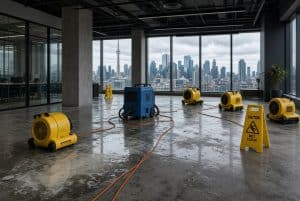
Classes describe the drying difficulty, based on how much material got wet and how porous it is. A Class 1 loss involves minimal wet material and low evaporation load. A Class 4 loss involves deeply saturated low-porosity materials such as concrete, hardwood, plaster, or masonry, which need specialty drying methods and longer schedules. A warehouse slab that has been wet for two days is often a Class 4 problem even when the visible water is gone.
Category 3 losses carry additional obligations. Health Canada identifies water contaminated with sewage, or with chemical or biological pollutants, as a situation requiring a qualified professional. [3]
The 48-Hour Mould Window, and What Health Canada Actually Says
In short: Health Canada states mould will begin to grow within 48 hours in an area with excessive moisture, sets specific size thresholds for when a professional is required, and advises against both air testing and bleach.
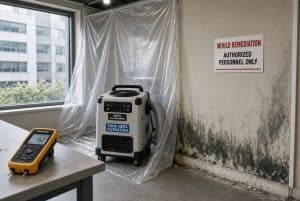
Most restoration marketing repeats a “24 to 48 hours” figure without attribution. The Canadian government position is more specific. Health Canada’s guidance states that immediate action is important because mould will begin to grow in an area with excessive moisture within 48 hours. [3] That is the number to plan around, and it is why drying starts before the building looks dry.
The more useful part of the guidance, and the part missing from every competing page in this market, is the size threshold table. Health Canada categorizes mould area three ways: [3]
| Extent | Definition | Path forward |
| Small | Three or fewer patches, total area under 1 square metre | May be cleaned with proper procedures and protective equipment |
| Medium | More than three patches, each under 1 square metre, total under 3 square metres | Professional assessment recommended, cleanup often possible without one |
| Large | A single patch larger than 3 square metres | Professional assessment and cleanup required |
Health Canada also flags several situations that require a professional regardless of visible area: mould that returns after cleaning, suspected hidden contamination inside walls or above ceilings, and flooding that has penetrated wall or ceiling cavities and cannot be dried by traditional methods. [3] In a commercial building, that last condition describes most losses of any size.
Two corrections worth carrying into any vendor conversation. First, Health Canada does not recommend testing the air for mould in most situations, because an air test does not provide information that predicts health effects and often says little about the cause of the damage. [3] Second, Health Canada states plainly that bleach should not be used to clean up mould. [3] Any contractor selling routine air sampling or bleach treatment as standard practice is working against published federal guidance.
Mould remediation itself is governed by a companion standard, ANSI/IICRC S520, which Health Canada cites directly in its own references. [4]
The Commercial Restoration Process, Step by Step
In short: Six phases, each producing a record. The drying phase is the one that takes real time, and it ends on a measured reading, not on a calendar date.
- Emergency site assessment. Scope the affected area, classify the water, map moisture with meters and thermal imaging, and identify materials that cannot be salvaged. This is where the drying plan is designed and where the insurer’s scope of work begins.
- Water extraction. Standing water comes out first with pumps and extraction units. Every hour that water remains raises the category and the drying load.
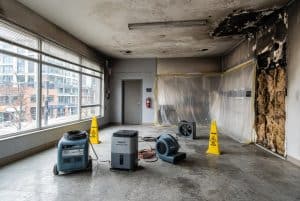
- Containment and structural drying. Affected zones are isolated so drying is efficient and unaffected tenants are protected. Air movers create the surface airflow that drives evaporation from walls, subfloors and cavities.
- Dehumidification and air quality control. Evaporated moisture has to leave the building rather than redeposit somewhere colder. Refrigerant and desiccant dehumidifiers pull it out, and HEPA filtration handles airborne particulate where contamination is a concern.
- Moisture monitoring. Readings are taken daily and logged against a dry standard established from unaffected areas of the same materials. Drying is not finished when surfaces feel dry. It is finished when the readings say so, which for a typical commercial loss runs three to five days and considerably longer for saturated concrete or masonry.
- Final inspection and clearance documentation. A closing set of readings, photographs and a clearance report that confirms the building met the dry standard. [13]
Contents are handled alongside the structure. Inventory, equipment, furniture, documents and stock affected by the loss are assessed for salvage, and items that can be recovered are often removed to an offsite facility for cleaning and drying while the building work continues. Ask early whether a contractor handles contents in-house or subcontracts it, because a pack-out adds its own inventory, storage and chain-of-custody record to your claim file.
Repairs and reconstruction follow, and are usually scoped separately from mitigation.
The Documentation Your Insurer Will Expect
In short: Moisture logs, a written scope of work, a dated photographic record, and a clearance report. Missing documentation is the most common reason a legitimate commercial claim gets reduced.
Restoration is a documentation business wearing work boots. The physical work is visible for about a week. The paperwork is what an adjuster, a broker, an owner and possibly a court will look at months later.
A complete commercial file contains:
- Daily moisture logs showing readings by location and by material, with the dry standard identified and the trend toward it.
- A written scope of work listing what was removed, what was dried in place, what equipment was deployed, and for how long.
- A dated photographic record, ideally beginning before anything was moved, covering the source, the affected areas, and the equipment set.
- Equipment logs showing counts and run hours, since drying invoices are usually built from them.
- A clearance or final inspection report confirming the building reached its dry standard.
- Chain of custody and disposal records for contaminated materials in a Category 3 loss.
Impact Restore’s stated practice on commercial losses includes moisture readings, photos, drying logs and a detailed scope of work provided as an insurance-ready package. [13] Ask any contractor to show you a redacted sample file from a past project before you engage them. A firm that documents properly will have one ready.
Nothing here is a statement about what a given policy covers. Coverage questions belong with your broker or adjuster. What a restoration contractor controls is the quality of the evidence.
When the Water Came From a City Sewer
In short: The City of Toronto pays flood and sewer backup claims only where negligence is proven, the 311 report is part of that proof, and the process typically takes about 90 days.
This is the section most restoration companies skip, and it is the one with money attached.
If water entered your building from the City’s storm or sanitary system, you may have a third-party claim against the City. The City is clear about the standard it applies. It can be held responsible for damage to private property caused by water escaping its infrastructure only where you establish the damage was caused by the City’s negligence. The City will not be responsible where Toronto Water met installation and maintenance standards, including where the service was installed in accordance with the engineering practices that prevailed at the time. [9]
Three practical consequences follow.
The 311 report is evidence, not paperwork. The City creates a record documenting calls to 311 reporting a flood or blocked sewer service line, along with the results of the investigation staff complete, and those inspection records play a role in the third-party claims investigation. [10] Skip the call and you have removed the City’s own record from your file.
Toronto Water is not the adjuster. The City notes that Toronto Water staff are not associated with its insurance adjusters and are not involved in managing insurance claims. [9] Reporting to 311 and filing a claim are separate actions.
Plan for a 90-day cycle. Property damage claims related to flood or sewer backup are typically completed within 90 days, and high-volume storm events extend that. [9] Meanwhile the Ontario basic limitation period gives two years from the day the claim was discovered to commence a proceeding, with a 15-year ultimate period regardless of discovery. [12] That is context for record retention, not legal advice. Get counsel for anything contested.
One correction for commercial owners: Toronto’s Basement Flooding Protection Subsidy Program is available to registered owners of single-family, duplex, triplex or fourplex residential properties within the City. [11] A commercial building does not qualify, whatever a general search result may imply.
What Drives Commercial Water Damage Costs in Toronto
In short: Category, class, square footage, material type, and access constraints. Anyone quoting a firm price before mapping moisture is guessing.
There is no honest average price for a commercial water loss, and any page offering one is selling. What can be described accurately are the variables that move the number.
Water category. A Category 1 loss caught early may need extraction and drying only. A Category 3 loss brings containment, protective equipment, antimicrobial application, and disposal of porous materials that cannot be cleaned, which can double or triple the scope on identical square footage.
Drying class and material. Drying a carpeted office is not drying a saturated concrete slab. Low-porosity materials hold moisture longer and need specialty equipment for longer, and equipment days are a primary cost driver.
Affected area and building height. Vertical migration through a multi-storey building multiplies affected units, and each one adds access coordination.
Access and scheduling. After-hours work, occupied-building phasing, tenant protection, and elevator or loading dock restrictions all add labour hours.
Response time. This one is within your control. Every hour before extraction begins increases absorption depth, raises the odds of category migration, and moves the 48-hour mould clock forward. [3]
Downtime. Often the largest number in the whole event, and the one that sits outside the restoration invoice entirely. Business interruption exposure is worth discussing with your broker before a loss, not after.
How to Choose a Restoration Contractor, Using Health Canada’s Criteria
In short: Health Canada publishes criteria for recognizing a qualified professional. Use them as a scorecard rather than relying on marketing claims.
Restoration is a low-barrier trade with high stakes, and the sales pages in this market are close to interchangeable. Fortunately there is a government-authored checklist. Health Canada identifies these markers of a qualified professional: [3]
- Certification from the IICRC, or OSHA-certified training, or equivalent training and experience.
- A preference for removing damaged materials that have been sites of mould growth rather than attempting to seal or chemically treat them.
- Liability insurance specifically covering mould removal where that work is involved.
- Written inspection and cleanup procedures provided to you, with actions, costs, health and safety considerations, warranties and follow-up inspections discussed up front.
- Laboratory accreditation to ISO/IEC 17025:2017 where any lab work is involved, administered by CALA, the Standards Council of Canada, AIHA, or an equivalent body.
- A recommendation that you hire a separate company for post-remediation clearance where extensive structural cleanup is involved.
That last point deserves emphasis. A contractor who suggests an independent third party verify their own work is demonstrating confidence, not weakness. Treat it as a positive signal.
Add seven commercial-specific questions of your own.
- Which edition of S500 do your technicians work to?
- Can I see a redacted sample documentation package from a past commercial project?
- What is your realistic response time to my postal code, not to the GTA generally?
- Do you carry the equipment capacity for my square footage, or would you be subcontracting it?
- Are you in good standing with WSIB, and can you produce a clearance certificate? In Ontario this protects the property owner from liability for the contractor’s workplace injuries, and it is a document, not a badge.
- Who is my single point of contact, and will one person coordinate between your crews, my broker and the adjuster?
- Can you stop the source, or do I need a separate trade for the plumbing repair before your crews can start?
Impact Restore’s technicians hold IICRC certification in water damage restoration, and the firm works commercial and industrial properties exclusively rather than blending residential and commercial crews. [13]
Reducing the Next Loss
In short: Most commercial water losses are foreseeable. Humidity control, backflow protection, and a pre-loss vendor agreement handle the majority of the exposure.
Control humidity year-round. Health Canada recommends maintaining relative humidity between 30 and 50 percent, and running a dehumidifier where moisture condenses on cold surfaces or humidity exceeds 50 percent. [3] In a commercial envelope this is a building automation setting, not a portable appliance decision.
Manage water at the perimeter. Keep eavestroughs and downspouts clear, confirm outflow runs away from the building rather than into a neighbouring foundation, and slope grade away from the structure. [3] Note that in Toronto, disconnecting downspouts from the City sewer system is a condition of the residential subsidy program, though the disconnection itself is not subsidized. [11]
Protect against backflow. Backwater valves and sump systems with alarms address the surcharge failure mode directly. Commercial installations are engineered rather than off-the-shelf, and are not covered by the City’s residential subsidy. [11]
Inspect the predictable failures. Water heaters, supply lines to appliances and fixtures, roof drains, sprinkler system components, and any pipe running through an unheated space. Check cardboard and stock stored directly on slab in warehouse space, which acts as a moisture indicator and a mould substrate at once. [3]
Sign a pre-loss agreement. A response agreement executed before an emergency, with your building’s drawings, shutoff locations and access protocols already on file, removes hours from the response. Those hours are the difference between a Category 1 loss and a Category 2 one.
Frequently Asked Questions
How fast should a commercial water damage company respond in Toronto?
Response time should be measured to your specific address, not to the region. Impact Restore states that its certified team arrives at commercial properties within two hours across the GTA, with faster tiers in the Toronto downtown core. [13] Ask any contractor for a response commitment tied to your postal code and building access constraints.
How long does commercial water damage restoration take?
Drying typically runs three to five days for a standard commercial loss, and considerably longer where concrete, masonry or hardwood is saturated. Drying ends when moisture readings reach an established dry standard taken from unaffected areas of the same material, not on a fixed schedule. Repairs and reconstruction follow separately.
How quickly does mould grow after water damage?
Health Canada states that mould will begin to grow in an area with excessive moisture within 48 hours. [3] That is why extraction and drying start immediately rather than after an insurance decision.
When is mould large enough to require a professional?
Health Canada classifies a single patch larger than three square metres as large, requiring professional assessment and cleanup. Three or fewer patches totalling under one square metre is small, and more than three patches totalling under three square metres is medium. [3] A professional is also required where water was contaminated with sewage, where mould returns after cleaning, or where flooding penetrated wall or ceiling cavities.
Should I have the air tested for mould?
In most situations, no. Health Canada does not recommend testing the air for mould, because an air test does not predict health effects and often says little about the cause of the damage. [3] A qualified professional may recommend a non-viable spore test in specific circumstances, such as unexplained concerns after inspection where there is a history of flooding or leaks affecting wall cavities.
Can I clean mould with bleach?
Health Canada advises against using bleach to clean up mould. [3] Non-porous surfaces can be cleaned with an unscented soap solution and dried completely. Porous materials that have grown mould generally have to be removed and discarded.
What is the difference between Category 1, 2 and 3 water?
Category 1 originates from a sanitary source, such as a supply line break. Category 2 carries significant contamination capable of causing discomfort or illness. Category 3 is grossly contaminated, including sewage backups and rising surface water. Categories worsen with time, so clean water left standing does not stay Category 1. [1]
Can I claim water damage against the City of Toronto?
Only where you can establish that the damage was caused by the City’s negligence. The City will not be responsible where Toronto Water met its installation and maintenance standards. [9] Property damage claims related to flood or sewer backup are typically completed within 90 days. [9]
Why does reporting to 311 matter for my claim?
The City states that failing to report the incident to 311, which denies Toronto Water the opportunity to investigate, could affect your ability to prove the damage resulted from the City’s negligence. [9] The City also creates an inspection record from those calls that plays a role in the third-party claims investigation. [10]
Does Toronto’s basement flooding subsidy apply to commercial buildings?
No. The Basement Flooding Protection Subsidy Program requires the applicant to be the registered owner of a single-family residential, duplex, triplex or fourplex property within the City of Toronto. [11] Commercial and industrial properties are outside the program.
What documentation should a restoration contractor give me?
Daily moisture logs with an identified dry standard, a written scope of work, a dated photographic record, equipment logs with run hours, and a final clearance report. For a Category 3 loss, add disposal records for contaminated materials. Ask to see a redacted sample package before engaging a contractor.
Which standard governs water damage restoration work?
ANSI/IICRC S500, Standard for Professional Water Damage Restoration. The current version is the fifth edition, published in 2021, and it covers residential, commercial and institutional buildings. [1][2] Mould remediation is covered by the companion standard, ANSI/IICRC S520. [4]
How much does commercial water damage restoration cost in Toronto?
There is no meaningful average. Cost is driven by water category, drying class, affected square footage, material porosity, building height, and access constraints such as after-hours or phased work. A contractor who quotes a firm figure before mapping moisture has not scoped the loss.
How do I verify a restoration contractor is qualified?
Health Canada’s criteria include IICRC certification or equivalent training, liability insurance specifically covering mould removal, a preference for removing damaged materials rather than sealing or treating them, written inspection and cleanup procedures provided in advance, ISO/IEC 17025:2017 lab accreditation where lab work is involved, and a recommendation to use an independent firm for post-remediation clearance. [3]
What happens to equipment, stock and documents damaged in the loss?
Contents are assessed for salvage alongside the structure. Recoverable items are often removed to an offsite facility for cleaning and drying while building work continues. Confirm whether a contractor handles contents in-house or subcontracts the work, since a pack-out generates its own inventory, storage and chain-of-custody records that belong in your claim file.
Should a restoration contractor be in good standing with WSIB?
Ask for a WSIB clearance certificate rather than accepting a logo on a website. In Ontario, confirming a contractor’s standing protects the property owner from liability for workplace injuries occurring on site. Pair it with proof of general liability coverage, and where mould work is involved, liability insurance specifically covering mould removal. [3]
How long do I have to act on a water damage claim in Ontario?
Ontario’s basic limitation period is two years from the day the claim was discovered, with a 15-year ultimate period running from the act or omission. [12] Specific claims can carry shorter statutory notice requirements, so anything contested warrants legal advice rather than a general guideline.
Sources
- Institute of Inspection, Cleaning and Restoration Certification. ANSI/IICRC S500 Standard for Professional Water Damage Restoration, Fifth Edition. IICRC, 2021. https://iicrc.org/s500/
- Institute of Inspection, Cleaning and Restoration Certification. Publication announcement, ANSI/IICRC S500 Fifth Edition. May 12, 2021.
- Health Canada. Guide to addressing moisture and mould indoors. Government of Canada, January 2023. https://www.canada.ca/en/health-canada/services/publications/healthy-living/addressing-moisture-mould-your-home.html
- Institute of Inspection, Cleaning and Restoration Certification. ANSI/IICRC S520 Standard for Professional Mold Remediation. Cited in Health Canada, January 2023.
- Insurance Bureau of Canada. Summer 2024 shatters records for severe weather damage. September 2024. https://www.ibc.ca/news-insights/news/summer-2024-shatters-records-for-severe-weather-damage-over-7-billion-in-insured-losses-from-floods-fires-and-hailstorms
- Catastrophe Indices and Quantification Inc. and Perils AG. Revised insured loss estimate, July 2024 Toronto flood. January 2025.
- Insurance Bureau of Canada. 2024 shatters record for costliest year for severe weather-related losses in Canadian history at $8.5 billion. January 13, 2025. https://www.ibc.ca/news-insights/news/2024-shatters-record-for-costliest-year-for-severe-weather-related-losses-in-canadian-history-at-8-5-billion
- Insurance Bureau of Canada. Severe weather-related insured losses in Canada exceed $2.4 billion in 2025. January 20, 2026. https://www.ibc.ca/news-insights/news/severe-weather-related-insured-losses-in-canada-exceed-2-4-billion-in-2025
- City of Toronto. Flood Claims. https://www.toronto.ca/city-government/accountability-operations-customer-service/complaints-claims-compliments/make-a-claim-against-the-city/flood-claims/
- City of Toronto. Basement Flooding. https://www.toronto.ca/services-payments/water-environment/managing-rain-melted-snow/basement-flooding/
- City of Toronto. Basement Flooding Protection Subsidy Program. https://www.toronto.ca/services-payments/water-environment/managing-rain-melted-snow/basement-flooding/basement-flooding-protection-subsidy-program/
- Limitations Act, 2002, S.O. 2002, c. 24, Sched. B, ss. 4 and 15. Government of Ontario.
- Impact Restore. Commercial Water Damage Restoration. https://impactrestore.ca/commercial-water-damage-restoration/